
Our gallery in Warsaw Old Town is open daily except holidays from 11.00 to 19.00 and it is our primary place of sale. We also sell in our gallery — after you order, we confirm the item is still available.
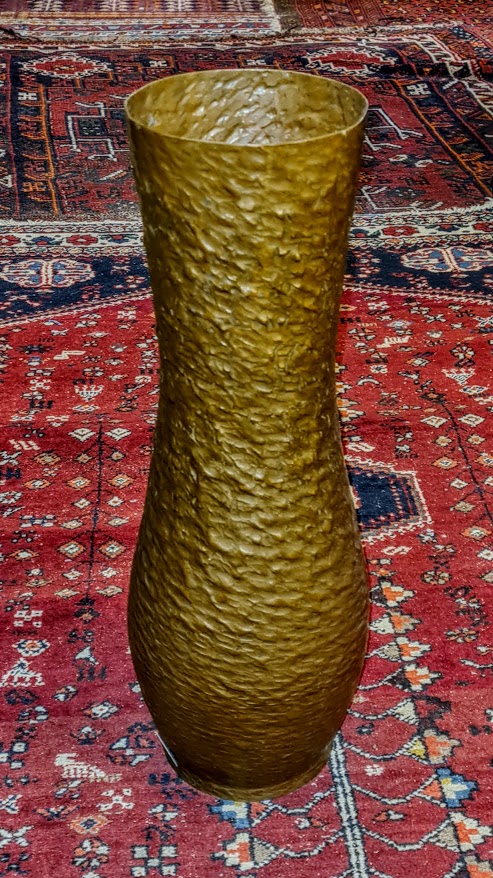
HAYNO FOCKEN. Large copper vase, repoussé 20th century. Germany
Na sprzedaż prezentowany jest unikatowy, duży wazon z miedzi, stanowiący doskonały przykład niemieckiego rzemiosła artystycznego (Kunstgewerbe) z pierwszej połowy XX wieku. Wazon jest sygnowany nazwiskiem wybitnego złotnika i projektanta – Hayno Fockena.
Przedmiot został wykonany w technice repusowania (tłoczenia), która nadaje mu niezwykle dekoracyjną, trójwymiarową fakturę. Forma i ornamentyka nawiązują do stylistyki Deutsche Werkbund, łącząc organiczne inspiracje późnej secesji z bardziej zgeometryzowanymi, modernistycznymi tendencjami, charakterystycznymi dla twórczości Fockena z okresu jego pracy w Hagen.
Ten kolekcjonerski wazon miedziany to prawdziwe dzieło sztuki użytkowej, które idealnie wpisze się w kolekcję rzemiosła artystycznego epoki modernizmu. Stan zachowania bardzo dobry, z piękną, naturalną patyną. Autentyczność potwierdzona czytelną sygnaturą autora.
Wymiary: 46 cm Stan: BARDZO DOBRY Sygnatura: "Hayno Focken" HF
Ships within: 72 hours
-
Hayno Focken (1870-1937) was a German goldsmith, designer and teacher. He worked in the transitional period between Art Nouveau (Jugendstil) and modernism.
-
He worked in important artistic centers: first in Düsseldorf, and later (from 1908) in Hagen, where he was called by the art patron Karl Ernst Osthaus.
-
He was associated with the Deutscher Werkbund movement and the idea of combining high-quality craftsmanship with industrial design. In Hagen he taught at the school of artistic craftsmanship founded by Osthaus.
-
He mainly created metal objects: vases, bowls, goblets, candlesticks, but also jewelry.
2. Characteristics of the item
-
Material: Copper. Focken often used copper, brass and silver, sometimes combining them with enamel or semi-precious stones.
-
Technique: Repoussé (also known as chasing). This is a technique that involves embossing the ornament in metal sheet from the underside, using a hammer and special tools. The effect is a beautiful, three-dimensional texture, often with organic, plant-like or geometric patterns.
-
Style: His early works bear traces of Art Nouveau (organic forms, sinuous lines). Later works, created in Hagen under the influence of Osthaus, become more geometric, concise and modernist. He created in the spirit of "applied art" (Kunstgewerbe).
-
Signature: Items are usually signed "Hayno Focken", often with the city name (e.g. Hagen). The signature "20th century. Germany" is rather a later, auction description of period and origin.
3. Value and collectibility
-
Hayno Focken items are appreciated on the antique market, especially in Germany and among collectors of early 20th-century European craftsmanship.
-
Value is influenced by:
-
Size: A large vase is more desirable than a small one.
-
Condition: Whether the copper is clean, has patina, or has no dents.
-
Quality of execution: The finesse of the repoussé.
-
Period: Works from the Hagen period (after 1908) are particularly prized.
-
Authenticity of the signature.
-
-
Financial value: A large, beautifully repoussé copper vase by Hayno Focken can fetch prices at auction from a few hundred to even several thousand euros (usually in the range of 1,000 - 4,000 €), depending on the factors mentioned above. BARGAIN PRICE AT LAPIDARIUM